
Why CB-SEM Continues to Dominate High-Impact Research ?
ServiceSetu
Premium01/02/2026
THE ADVICE
Why Mastering CB-SEM Using AMOS Is a Career-Defining Skill for Researchers and Academics
In today’s publish-or-perish academic ecosystem, the difference between an average manuscript and a top-tier journal publication often lies in the rigour of the research methodology. Among advanced quantitative techniques, Covariance-Based Structural Equation Modeling (CB-SEM) has emerged as a gold standard for theory testing, construct validation, and causal modelling—particularly in management, social sciences, psychology, and interdisciplinary research.
For researchers aiming to publish in ABDC-listed, SSCI, SCIE, and FT-50 journals, mastering CB-SEM using AMOS is no longer optional—it is a career-critical capability.
This article explains why CB-SEM matters, how it strengthens academic careers and research impact, and how a structured, hands-on FDP can help you move from software execution to methodological confidence.
Why CB-SEM Continues to Dominate High-Impact Research
CB-SEM is designed for theory-driven research, where the objective is not just prediction but testing theoretically grounded relationships among latent constructs.
Leading journals consistently prefer CB-SEM when research focuses on:
Theory confirmation and extension
Measurement validation
Hypothesis testing
Mediation and indirect effects
Model fit and explanatory adequacy
Unlike exploratory or purely prediction-oriented approaches, CB-SEM provides statistical evidence for theoretical claims, making it indispensable for doctoral research, post-doctoral work, and faculty publications.
AMOS: The Preferred Tool for Theory-Driven SEM
AMOS remains one of the most widely accepted tools for CB-SEM due to:
Its graphical, intuitive interface
Strong acceptance by journal reviewers and editors
Robust handling of CFA, structural models, and advanced extensions
Clear visualisation of latent variables and path structures
For researchers struggling with reviewer comments on measurement validity, model fit, or mediation logic, AMOS-based CB-SEM often provides the missing methodological clarity.
How CB-SEM Skills Accelerate Academic Career Growth
1. Stronger Journal Publications
Researchers trained in CB-SEM can:
Defend construct validity with CFA
Report model fit indices confidently
Justify mediation and indirect effects
Respond effectively to reviewer critiques
This significantly improves acceptance probability in A/A and SSCI journals*.
2. Faster PhD Completion
Doctoral scholars often face delays due to:
Weak measurement models
Confusion between PLS-SEM and CB-SEM
Poor handling of common method bias
A structured CB-SEM approach reduces revisions, strengthens chapters, and improves examiner confidence.
3. Enhanced Teaching and Supervision Capability
Faculty members proficient in CB-SEM:
Teach research methods with authority
Supervise doctoral theses more effectively
Contribute to FDPs, workshops, and funded projects
This directly supports academic leadership and promotion.
What This FDP Offers: From Theory to Publication Readiness
The Three-Day Faculty Development Programme on CB-SEM Using AMOS is designed to bridge the gap between conceptual understanding and applied research execution.
Day 1: Measurement Models & Confirmatory Factor Analysis (CFA)
Participants will gain clarity on:
Foundations of CB-SEM and latent variable modelling
CB-SEM vs PLS-SEM: when and why
Reflective construct specification
CFA execution using AMOS
Model identification and goodness-of-fit indices
Reliability and validity (CR, AVE, discriminant validity)
Reporting CFA results for high-quality journals
Career value: Strong measurement models that withstand reviewer scrutiny.
Day 2: Structural Models & Common Method Bias (CMB)
This session focuses on:
Structural model specification and hypothesis testing
Direct, indirect, and total effects
Theory-driven model respecification
Understanding sources of Common Method Bias
CMB diagnostics using multiple CFA and unmeasured method factor approaches
Best practices in interpreting and reporting SEM results
Career value: Ability to defend causal claims and address reviewer concerns on bias.
Day 3: Advanced CB-SEM Extensions – Bifactor Modeling
Advanced topics include:
Rationale for bifactor models
Bifactor SEM vs second-order factor models
Interpreting general and specific latent factors
Introduction to bifactor ESEM
Common pitfalls and publication-oriented insights
Career value: Capability to publish methodologically sophisticated studies in top journals.
Learn from an Experienced Resource Person
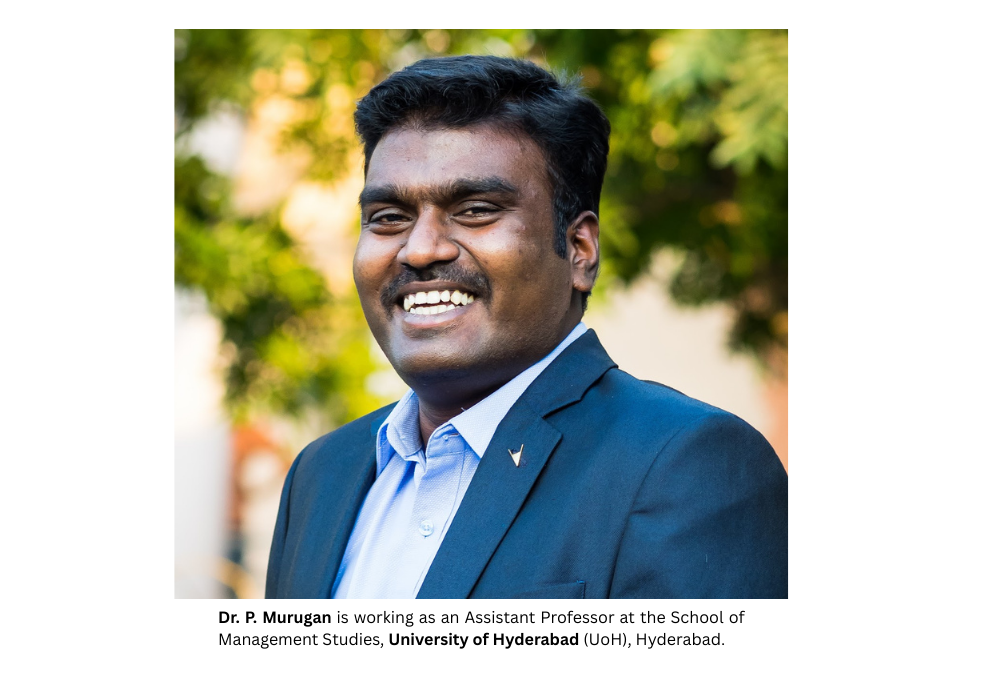
The FDP is led by Dr. P. Murugan,
School of Management Studies, University of Hyderabad

Dr. P. Murugan is working as an Assistant Professor at the School of Management Studies, University of Hyderabad (UoH), Hyderabad. He has completed his PhD from Anna University, Chennai, and worked with IIM Shillong, Australian Council for Educational Research, New Delhi, and National Institute of Technology, Tiruchirappalli.
He received the University of Hyderabad's chancellor's award for his contributions to both teaching and research.
He has a passion for research, and he has been a resource for more than 290 workshops and FDP programs held at many universities and B-Schools in India.
His expertise lies in the areas of Multivariate Data Analysis Techniques, Mediation Analysis, Moderation Analysis, Structural Equation Modeling, and Item Response Theory. His papers have been published in SSCI, ABS, and ABDC-listed journals. He has developed online lecture videos for three of the courses offered through the SWAYAM platform.
Who Should Attend This FDP?
This programme is ideal for:
Faculty Members seeking publication excellence
PhD Scholars working on empirical theses
Post-Doctoral Fellows aiming for top-tier journals
Research Associates involved in advanced quantitative projects
Workshop Details
Programme: Covariance-Based Structural Equation Modeling (CB-SEM) Using AMOS
Dates: 26–28 February 2026
Time: 2:30 – 5:30 PM (IST)
Format: Online | Hands-on | Publication-oriented
Final Thought: Methodological Rigor Is Academic Capital
In contemporary academia, ideas gain impact only when supported by rigorous methods. CB-SEM using AMOS equips researchers with the analytical credibility, confidence, and clarity needed to publish, supervise, and lead.
If your goal is career growth, high-impact publications, and research excellence, this FDP is not just training—it is a strategic academic investment.
COMMENTS (0)
Sign in to join the conversation
SIGN IN TO COMMENT