
New Income-tax Act, 2025: A Comprehensive Guide | The Institute of Chartered Accountants of India (ICAI)
Post Type
Published Date
29/09/2025
Author
ServiceSetu
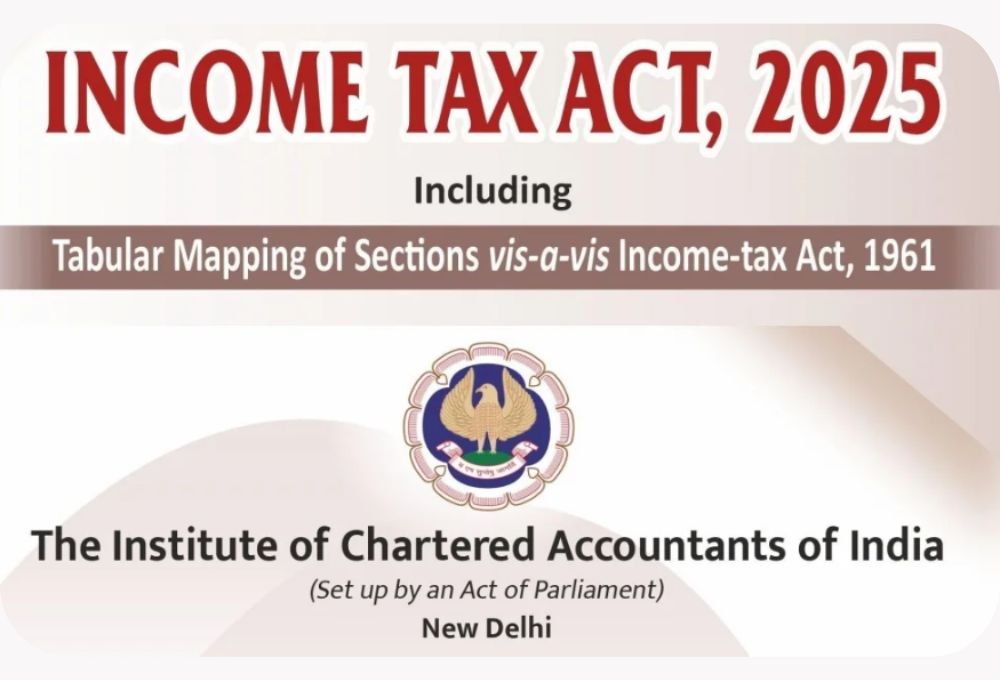
Understanding the New Income-tax Act, 2025: A Comprehensive Guide
Introduction
On 21st August 2025, the President of India gave assent to the Income-tax Act, 2025 (No. 30 of 2025), marking a historic reform in India’s direct tax framework . This Act consolidates and amends the law relating to income tax, replacing the six-decade-old Income-tax Act, 1961. The new law will come into effect from 1st April 2026, applicable for the Assessment Year 2026–27 onwards.
The reform follows the Union Budget 2024–25 announcement to simplify, rationalise, and modernise income-tax law. The Institute of Chartered Accountants of India (ICAI) was actively involved in consultations, with over 90 of its suggestions incorporated in the final legislation .
Key Objectives of the Income-tax Act, 2025
The new Act is designed with three guiding principles:
- Simplification: Elimination of complex provisos, shorter sentences, and tabular presentation of provisions to make the law more readable .
- Digital Integration: Emphasis on faceless assessment, electronic submissions, and alignment with digital record-keeping.
- Global Alignment: Harmonisation with international best practices in taxation, transfer pricing, and anti-avoidance measures.
Major Highlights of the New Law
1. Structural Reorganisation
- The Act contains 14 chapters and over 500 sections, reorganised for logical flow.
- A tabular mapping has been provided to link each section of the 2025 Act with its corresponding provision under the 1961 Act .
- For example, “Profits and Gains from Business or Profession” (old Sec. 28–44DA) are reorganised into Sections 26–66 in the new law.
2. New Definitions & Clarity
- Clear definitions of “assessee,” “capital asset,” “business trust,” and “charitable purpose” are included with modern contexts .
- Agricultural income, digital assets, and new forms of business entities are explicitly covered.
3. Taxation of Individuals & Companies
- New Tax Regimes for individuals (Sec. 202) and corporates (Sec. 199–205) continue with reduced rates but limited deductions .
- Minimum Alternate Tax (MAT) and Alternate Minimum Tax (AMT) have been simplified (Sec. 206).
4. Rationalised Exemptions & Deductions
- Deduction schedules (Sec. 122–154) are reorganised, with clarity on:
- Life insurance & provident fund contributions (Sec. 123).
- Health insurance, higher education loans, housing loans, and EV purchases (Sec. 126–132).
- Political contributions, charitable donations, and SEZ-related deductions (Sec. 133–144).
5. Anti-avoidance & International Provisions
- Transfer Pricing rules (Sec. 161–177) strengthened with safe harbour and advance pricing agreements.
- General Anti-Avoidance Rule (GAAR) provisions retained (Sec. 178–184).
- Clearer framework for non-residents, pass-through entities, and shipping companies (Sec. 207–235).
6. Administration & Compliance
- Taxpayer’s Charter introduced as a statutory right (Sec. 240) .
- Faceless assessments, jurisdiction, and information collection powers are codified (Sec. 236–261).
- PAN and return filing provisions (Sec. 262–264) simplified for wider compliance.
Why This Reform Matters
The Income-tax Act, 2025 is more than a legal overhaul – it is a strategic reform aimed at:
- Reducing litigation through clarity.
- Enabling ease of doing business.
- Supporting Digital India by embedding electronic processes.
- Aligning India with global tax standards to attract investment.
As ICAI notes, this Act marks the beginning of a “taxpayer-friendly era” by balancing the needs of the exchequer with compliance simplicity .
Conclusion
The Income-tax Act, 2025 represents one of the most transformative changes in India’s fiscal history. By simplifying the legal structure, embracing digital compliance, and aligning with international practices, it lays the foundation for a modern, transparent, and efficient tax regime.
Professionals, businesses, and individuals must now familiarise themselves with the new structure, especially since the Act will govern assessments from FY 2025–26 onwards.
📌 References for Further Reading:
Comments (0)
Sign in to join the conversation
Sign In to Comment