
Viksit Bharat Shiksha Adhishthan Bill, 2025: Transforming India’s Higher Education Regulatory Framework
Post Type
Published Date
31/12/2025
Author
ServiceSetu Team
Viksit Bharat Shiksha Adhishthan Bill, 2025: A Landmark Reform in Indian Higher Education
The Government of India has introduced the Viksit Bharat Shiksha Adhishthan Bill, 2025, a transformative legislative initiative aimed at reshaping the governance and regulatory framework of higher education in the country. Spearheaded by the Ministry of Education and supported by the University Grants Commission (UGC), the Bill aligns closely with the long-term vision of the National Education Policy (NEP) 2020.
This reform seeks to simplify regulations, enhance institutional autonomy, and ensure global standards of quality in higher education.
Background and Rationale
India’s higher education system has historically been governed by multiple regulatory bodies, including the UGC, AICTE, and NCTE, often leading to overlapping roles, procedural delays, and compliance complexities. The Viksit Bharat Shiksha Adhishthan Bill, 2025 addresses these challenges by proposing a unified and streamlined regulatory architecture.
Key Features of the Bill
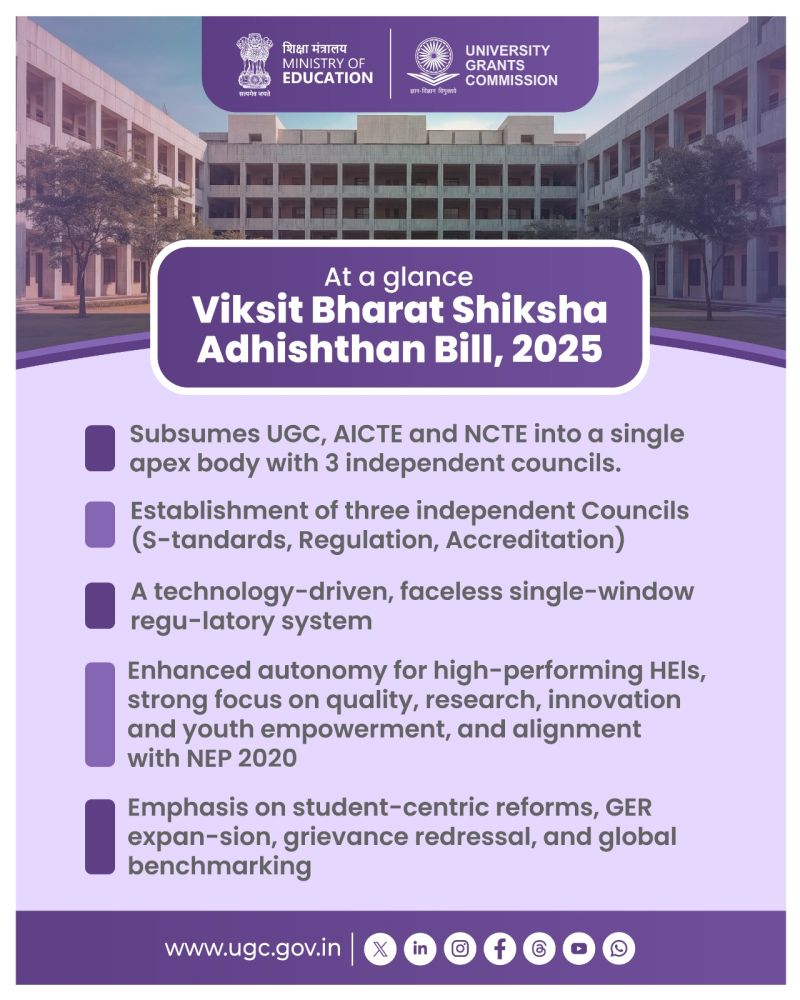
1. Single Apex Regulatory Body
The Bill proposes the merger of UGC, AICTE, and NCTE into a single apex body, ensuring cohesive policy-making and uniform standards across all disciplines of higher education.
2. Three Independent Functional Councils
To ensure efficiency and specialization, three autonomous councils will function under the apex body:
- Standards Council – to define academic and institutional benchmarks
- Regulation Council – to oversee compliance and governance
- Accreditation Council – to manage quality assurance and institutional assessment
3. Technology-Driven, Faceless Governance
A digital, faceless, single-window regulatory system will replace traditional manual processes, enhancing transparency, reducing human intervention, and improving ease of compliance for institutions.
4. Enhanced Autonomy for High-Performing Institutions
Institutions demonstrating strong academic and research performance will be granted greater academic, administrative, and financial autonomy, fostering innovation and excellence.
5. Strong Focus on Quality and Research
The Bill emphasizes:
- Promotion of research and innovation
- Improved teaching-learning outcomes
- Strengthening India’s global academic standing
6. Student-Centric Reforms
Special focus has been placed on:
- Gross Enrolment Ratio (GER) expansion
- Effective grievance redressal mechanisms
- Global benchmarking of Indian institutions
- Inclusive and learner-focused education policies
Alignment with NEP 2020
The Viksit Bharat Shiksha Adhishthan Bill, 2025 operationalizes the core principles of NEP 2020, including:
- Light but tight regulation
- Institutional autonomy
- Multidisciplinary education
- Quality assurance and accountability
Expected Impact
The implementation of this Bill is expected to:
- Reduce regulatory burden on HEIs
- Improve governance efficiency
- Encourage innovation-driven education
- Enhance global competitiveness of Indian universities
- Strengthen trust and transparency in higher education administration
The Viksit Bharat Shiksha Adhishthan Bill, 2025 represents a decisive step toward building a future-ready, globally aligned, and student-focused higher education ecosystem. By simplifying regulatory structures and empowering institutions, the Bill lays a strong foundation for achieving the vision of a developed and knowledge-driven India.
Comments (0)
Sign in to join the conversation
Sign In to Comment